YOUR PORTABLE GENERATOR BUYING GUIDE

<------------------------------------------------------------------------------------------------------------------------------------------------------------->
HOW DOES IT WORK
There are many cases when grid is not available and you may need electric power: during blackouts, on camping trips or on a job site. Portable generators are intended to temporarily provide electricity by burning fossil-based fuels. Let's take a closer look at these devices and find out how they work.
Unlike standby systems, portables normally are not permanently installed and can be easily moved from place to place.

Portable generators are currently available for sale in the power range from 500 watt to 17.5 kW. They can be very handy after the loss of electricity in the wake of a storm or other unforeseen circumstance. There are more than thirteen million of such devices in U.S. households, and about one million units is bought per year according to U.S. Consumer Product Safety Commission (CPSC). Homeowners are the largest buyers of light-duty gensets, accounting for about half of light duty sales, primarily in the 3 to 10 kW range.
BASIC FEATURES and SPECIFICATIONS
OUTPUT POWER. Manufacturers usually specify running watts and starting watts. The former is the amount of power the device can produce continuously. The latter is the short burst of power it can produce to run appliances like an a/c whose surge current can exceed steady state current. Note that manufacturers often advertise their portable gensets by starting watts rather than by running watts. Also note that single-phase gensets are usually rated for loads with power factor PF=1, that is for loads with volt-amps equal to watts. Since all motor-driven appliances (such as refrigerators and air conditioners) as well as old computers and electronics without power factor correction have relatively low PF, their VA demand may be 25-70% higher than their wattage. For more details see this wattage guide.
FUEL TYPE. Depending on the model, the engine can run on gasoline, diesel, commercial propane, natural gas, and bio-diesel. Some models can use multiple sources. Your choice of fuel should be determined by how you are going to use the genset and how often. Gasoline-fueled
 devices are generally the least expensive. However, this is probably their only advantage. There are plenty articles around written by various "experts" suggesting to get a gas-powered portable generator as a part of a disaster preparedness. In reality, a gasoline model may be a good choice on construction sites and camping trips, but it is not intended for a long-term emergency.
If you are looking for a reliable backup power device for a possible major blackout, the main factor to consider is how you are going to keep your emergency source fueled. The problem with gasoline is the challenge of storing. Its fumes are highly flammable, which makes storing of large amount of gas unsafe. For example, the NFPA fire code allows us to keep not more than 25 gallons of gas in residential buildings. A typical 5000W generator running at rated load will consume this amount in about 25-30 hours. So, you may run out of fuel in one day, while during a wide-spread power outage gas pumps may not work. Also note that gasoline has a typical shelf life of about six months, although some stabilizers are claimed to extend it for up to 2 years.
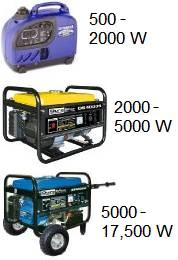
This is how typical portable gensets look like.
In my view, propane, diesel and natural gas are better choices for emergency use. As opposed to gasoline, large quantities of diesel and propane can be stored safely in large cylinders. In addition to this, these two types deteriorate much less over time than gasoline.
Propane practically does not deteriorate with time (well, you can store it for at least 2 years). It is the only type of fuel that does not require electricity for a refill. Although home improvement stores carry mainly gas-fueled devices, propane models can be found online.
Diesel is less flammable than gasoline. It likewise may be not available during a widespread blackout, but it can be kept in large tanks. Diesel gensets are the most efficient and reliable of all types, but they are also the most expensive.
I am not aware of any device designed specifically to work on biodiesel, but today's diesel gensets will usually run on biodiesel as well. There was a report about a prototype of a device that works on food, paper and plastic trash that has been developed at Purdue University. Unfortunately, currently it aims for a military use.
Natural gas can assure practically unlimited service, but it is used primarily in permanently installed standby devices. Natural gas powered portable gensets are rare, relatively expensive, and need professional installation of the fuel line, which somewhat defeats the purpose of portability.
In conclusion, let's quickly go over the options. Among the most useful ones are voltage regulator, electric start, a wheel kit, and low oil level sensor. If you are going to run some sensitive electronics, you may want a device with low T.H.D (<5%).
WHAT TO CHOOSE
. For non-emergency applications price may be the main factor in choosing the right device. If so, a cheap gasoline model may be your first choice. For a disaster preparedness however, the main considerations should be given to the convenience of fuel storage and fuel availability during an emergency. In this case, in my view, the preference should be given to propane. For job site you may want to pick a diesel because of its longevity. See my eBook for a detailed review of portable generators, step-by-step sizing procedure and connection methods.<----------------------------------------------------------------------------------------------------------------------------------------------->